
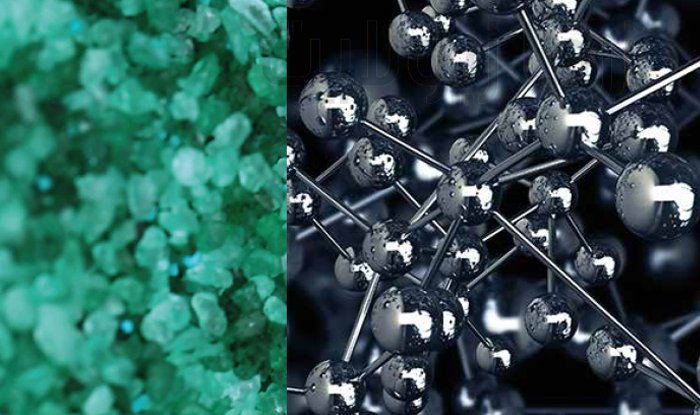
About Zeolite

What is Zeolite?

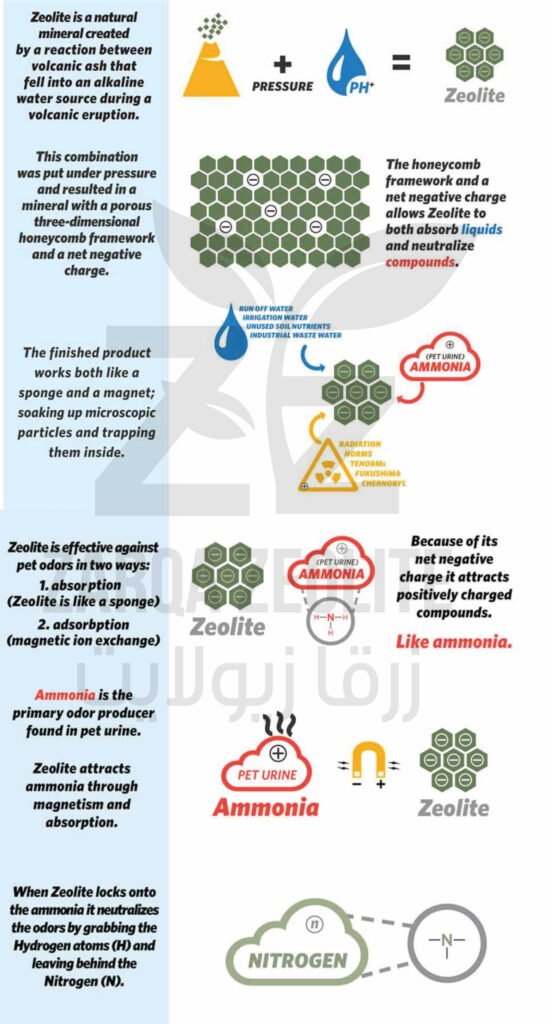
Zeolite is a type of natural mineral and rock, formed by the decomposition of volcanic rocks and their interaction with alkaline waters. It forms unique crystals in shape and properties from aluminum silicates, known as “molecular sieves.” These minerals are characterized by a low specific gravity, due to the presence of voids that constitute 35% to 50% of the crystal volume. Zeolite has a three-dimensional lattice structure resembling honeycomb, composed of layers with interconnected channels and voids where positive ions and water molecules are concentrated.

The ions within the zeolite structure can be easily exchanged with nutrients without affecting their composition, a property known as Cation Exchange Capacity. Water molecules can also be lost and gained with the same ease, giving zeolite its hydration and dehydration properties.
Zeolite Characteristics

The diverse properties of zeolite, such as its low density, high void ratio, ability to absorb water, ion exchange capacity, stability of crystal structure upon heating and dehydration, homogeneous distribution of channels and voids, ability to absorb gases and water vapor, and high surface area, contribute to its various applications.

General Benefits of Zeolite in Agriculture:
  • Increased water use efficiency.

  • Increased fertilizer use efficiency.

  • Increased production yield per unit area.

  • Improved production quality (taste, storage duration, etc.).

  • Reduced incidence of diseases, especially those related to soil.

  • Reduced negative physiological phenomena such as tip burn and blossom end rot.

  • Restoration of soil’s ability to support proper plant growth.

  • Reduced costs and increased profits.

  • Increased water holding capacity of the growth medium (retains water within its crystals, on its surface, and within its pores at a rate of no less than 50% of its weight, which reduces evaporation rates and preserves moisture).

  • Increased ion exchange capacity of the growth medium (can retain essential plant nutrients within the root zone in an available form).

  • Rejuvenation of degraded agricultural soils.

Application Methods and Rates
  • Addition to Natural Soil: Zeolite is added at a rate of 3 kg/m² and mixed with the soil by tilling and cultivating to a depth of 30 cm. It is important to choose the correct zeolite particle size according to the soil type.
  • Addition to Other Growing Media (Peat moss, Cocopeat, Volcanic Tuff, etc.): Mixed at rates ranging from 15-50% of the growing medium volume, and can also be used alone in some types of cultivation. It is important to choose appropriate zeolite sizes and ratios, depending on the type of growing medium, crop, and cultivation method.
  •  
keyboard_arrow_up